
The Aretha Series, Part One: Aretha's Arrival
When, where, and how a genius burst through. Date: January 24, 1967. Place: Fame Music in Florence, AL. Supporting cast: the legendary Swampers. Yield: "I Never Loved a Man the Way That I Love You."

Note: I wrote this, and the several pieces that will follow, as part of an overview of Aretha Franklin’s entire life and career. It appeared in the journal popmatters in 2021. The stories that will appear here are in radically different form from the popmatters original. This is essentially a whole new series that follows Aretha through her greatest years (roughly, 1967-1972). I hope you enjoy reading it as much as I have writing it.
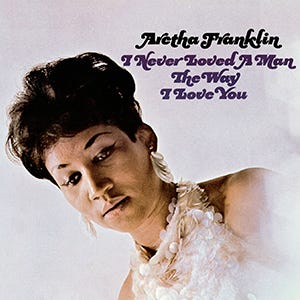
Aretha Franklin’s first Atlantic Records album (1967), on which the 24-year-old was finally given the opportunity to display her deep soulfulness.
IT CAME AS A REVELATION to Jerry Wexler: the way they made records, that is, at Fame Music, a cinderblock bunker in Florence, Alabama, one of four little towns in the northwest corner of the state. Florence, Muscle Shoals, Sheffield, and Tuscumbia were collectively known as Muscle Shoals. after a misspelled stretch of the Tennessee River once known for its shellfish.
None of the half-dozen or so musicians in Fame’s house band, shortly and universally to be known as The Swampers, could read music. You didn’t have to read music to learn the five chords to “When a Man Loves a Woman,” recorded at Fame in February 1966 by Percy Sledge, an orderly at nearby Colbert County Hospital. Released in March, the song soared to #1 on Billboard’s Hot 100, and Fame was on the map.
Wexler, Atlantic Records’s co-owner and the producer of a long string of hits, oversaw the production of “When a Man Loves a Woman” from New York. As Sledge’s song leapfrogged up the charts, Wexler flew a hot new Atlantic artist to Muscle Shoals. Working with Wexler, Atlantic’s staff engineer, Tom Dowd, and Rick Hall, Fame’s founder/owner, Wilson Pickett cut three million-selling singles in a row: “Land of 1,000 Dances, “Mustang Sally” and “Funky Broadway.”1
At Fame, a client rarely came in with a prepared arrangement. “The clients that Fame got were looking for creators,” said tenor saxophonist and horn arranger Charlie Chalmers, a part-time Swamper. “And that’s what the Fame guys were. We worked out arrangements on the spot,” more or less through osmosis. “When we got in the studio,” Chalmers told me, “we started jamming, and almost right away everybody knew what to play. We were so used to working together, we almost had telepathy. All we had to do was look at each other.”
All of the Swampers were under 30. Roger Hawkins, the drummer, was just 21. “I was raw,” said Hawkins, who grew up on a dirt road outside Florence. “The first song I cut, when I listened back, there was this squeaky sound every time I hit the bass drum. I learned a valuable lesson: oil the bass drum pedal.” By his mid-to-late twenties, Hawkins was one of the best session drummers in the country, who either had or shortly would cut records with Eric Clapton, Bob Seger, Cat Stevens. Joe Cocker, the Staple Singers, and Traffic. That’s Roger’s irresistible groove propelling Paul Simon’s 1973 hit “Kodachrome.”
“Roger just had the fire,” Chalmers says. “Just as important, he knew when to hold back. Roger never overplayed. He laid that backbeat in there, and when he played a fill it was at just at the right spot.” As Chalmers tells it, when Hawkins broke in David Hood, a 22-year-old trombonist, as the Swampers’ bass player, “Roger told David, ‘Just play what I’m playing on my foot.’ That was Roger’s rule for David,” and it was what gave the Swampers’ sound its rock-solid bottom.2
Jimmy Johnson, one of two guitarists, played strictly rhythm; he never soloed. Jimmy had been Fame’s first full-time employee: bookkeeper. His logistical smarts were at least as vital to Fame’s success as his guitar playing. Chips Moman was the one with the guitar chops.“Chips had a knack for coming up with great licks,” said Johnson, “just bam, on the spur of the moment,” like the stinging two bars that open Aretha’s “Respect.” Chips was happiest, though, in the sound booth pushing faders. He turned his Memphis studio American Sound, which he built for $3,000 in 1964, into one of the country’s top recording centers. In the late 1960s and early ‘70s, American was responsible for more than a hundred Billboard Hot 100 hits. At one point, the place accounted for more than a quarter of the Hot 100. Chips cut hits on Dusty Springfield, the Box Tops, Neil Diamond, and produced Elvis’s 1969 comeback album, Elvis in Memphis, as well as “Suspicious Minds,” Presley’s last #1 single.
Until David Hood got his sea legs, Tommy Cogbill played bass. “Tommy was forceful,” said Jimmy Johnson. “Tommy would push you right out the door,” and played fine lead guitar when called on.
Fame’s keyboardist, Spooner Oldham “was one of the most reserved people you ever met,” Johnson said. “He was quiet almost to the point of mute,” and so skinny the others fretted about his health. The Swampers’ secret weapon, Spooner would diddle around until he found a spot where nobody else was playing and drop in the perfect lick; suddenly, everything jelled. Spooner avoided the spotlight and he avoided spats. When tempers flared he kept his mouth shut.
Charlie Chalmers was out of Memphis; he’d dropped out of Memphis State College to go on the road with Jerry Lee Lewis. A fluent sight reader, Charlie was a sought-after horn arranger on Memphis’s busy recording scene. And he could play—the fine tenor sax solo on Wilson Pickett’s “Land of 1,000 Dances” is Charlie’s.
IT WAS DURING PICKETT’S “MUSTANG SALLY” session, in October 1966, that Jerry Wexler got a call from a friend. “Write down this phone number,” said Louise Bishop, a Philadelphia gospel disc jockey. “Aretha Franklin is waiting for your call.”
Wexler had long been watching Aretha’s erratic, misdirected career at Columbia Records. Columbia’s John Hammond, who’d signed Aretha in 1960, cautioned Wexler that she was moody and withdrawn, but Wexler was willing to to take the risk.
When he called the number Louise Bishop gave him, Aretha’s husband and manager, Ted White, answered. Until not long before he met Aretha, White was a small-time Detroit hustler. (Detroit was Aretha’s hometown.) The singer Bettye LaVette called White “a gentleman pimp.” Harvey Fuqua, a Motown executive, went LaVette one better. “Anyone who didn’t see Ted White as a straight-up pimp had to be deaf, dumb and blind.” Her marriage clearly mirrored the worst aspects of Aretha’s troubled relationship with her father. Just like the famous Rev. C.L. Franklin, Ted White was domineering, didn’t mind slapping women around, and wanted a strong hand in Aretha’s career. Ted White bullied his wife from day one.3
It didn’t take long for Wexler and White to come to terms, and Aretha was right where she belonged: in the pocket with the Swampers. As the Alabama-born songwriter and auxiliary Swamper Dan Penn, put it,”Down here, it was black people singing and we did the picking and grinning. The mixture of two colors of people: that’s my rhythm and blues. That mixture produced a certain kind of music that people loved. I know I did.”
Penn was talking about a peculiarly American set of circumstances first spelled out by another Alabaman, the great writer Albert Murray, to whom America was, as Murray put it, “culturally mulatto,” especially in the South, where blacks and whites had lived cheek by jowl ever since the arrival of the first settlers and their slaves, sharing folkways, religion, music, customs, manners of speech: culture.
Sam Phillips himself, the great producer (born, that’s right, in Florence, Alabama), who discovered Elvis, Jerry Lee Lewis, Johnny Cash, B.B. King, Howlin’ Wolf, Ike Turner, and a number of others, knew that even, that especially, in the South, the races shared far more than what kept them apart. “Color be damned,” as Jimmy Johnson said, “we were all coming from the same place.”
When Rod Stewart, a white man with soul to burn, came to Muscle Shoals to record his 1975 album Atlantic Crossing, Atlantic’s engineer, Tom Dowd, greeted him. Stewart saw a bunch of dowdy-looking white guys tuning guitars and fiddling with amps: the studio factotums, Stewart assumed.
“When does the band get here?” he asked Dowd.
“That is the band.”
To Jerry Wexler, it was a no-brainer. Aretha was Alabama-bound.
IF RICK HALL HAD ONLY A VAGUE IDEA of who Aretha Franklin was, Chips Moman knew all about her. “I’d been raving about Aretha since 1959,” Chips said. “She was one of the greatest singers I ever heard, even back then.” Dan Penn couldn’t have agreed more. “Rick didn’t know who the hell was coming in,” Penn recalled. “I said, ‘Who you got?’ He said, ‘Aretha Franklin.’ I said, ‘Boy, you better get your damn shoes on.’ Penn and Chips started putting together a song, “Do Right Woman,” which they considered a natural for Aretha and planned to pitch to Wexler.
On the afternoon of January 24th, 1967, Jerry Wexler, Tom Dowd, a 24-year-old Aretha Franklin, and Ted White arrived at Fame. Aretha had a song she wanted to try. An unknown songwriter named Ronnie Shannon had approached Ted White in Detroit. White told him to write a song for Aretha, and Shannon was back in fifteen minutes. (Rock lore is full of fifteen-minute masterpieces).
When Aretha heard the song, ”I Never Loved a Man the Way I Love You,” she was strongly drawn to it. The last thing that would have occurred to Ted White was that if Aretha sang it, and whether she consciously realized it or not, the song would be aimed straight at him. I don’t know why I let you do these things to me.... She was ready to transmute self-abnegation into art.
It’s hard to understand Wexler’s logic in not initially putting Aretha behind the piano; he had to have been aware of how organically her singing and playing were connected. But when Spooner Oldham arrived, Wexler pointed him towards the piano.
“She was gonna stand up in front of the microphone and sing,” Spooner said. “She was showing us this song she had brought with her, and she hit this magic chord.” Nobody remembers what it was, but all present have told the same story: Aretha walked in all business, sat down at the piano, and hit a chord that stood their hair on end. Spooner approached Wexler, telling the producer that he was not trying to cop out or nothing, but he wished Wexler would let Aretha stay at the piano. Spooner was happy to move to the studio’s little Hammond spinet. Wexler agreed “and that’s the way it was,” said Spooner. “It was one of the best things I ever done, and I didn’t do nothing.” 4
Magic chord or not, Aretha had, atypically, come to Muscle Shoals unprepared. As Ronnie Shannon had dashed the thing off, “I Never Loved a Man” was an ungainly mess. When Aretha sat down to run it by the band, they were baffled. They couldn’t even tell what key it was in, if any. Nor did it have a discernible meter. Everyone just sat there, wishing they could figure out how to get things rolling.
“But one little guy sittin’ over at the electric piano named Spooner Oldham,” said Dan Penn, “out of nowhere, out of two minutes of nobody saying a word, here comes Spooner” with a simple, propulsive two-chord riff in 3/4 time.
“Spooner’s got it!” Chips Moman shouted.
“They all kind of looked at me,” Spooner said. “I just kept playing what I was doing,” and, after riding Spooner’s lick a little while, Aretha bit off those accusatory opening lines:
You’re a no-good
Heartbreaker
You’re a liar
And you’re a cheat.
“And from there,” said Penn, “it was like sparkles and shine. She had a roomful of instant fans.”
The first masterpiece of Aretha’s golden era: a transmutation of self-abnegation into art
Roger Hawkins locked into Spooner’s waltz time, hitting his snare drum on the third beat of every measure. For that common-sensical move, Drum magazine called Roger “the inventor of the soul waltz.” “I just put the cross stick on beat three,” said the diffident drummer. “I don’t really know how that made me the father of the soul waltz.”
The song is harmonically simple, the I, IV, and V chords—F, B-flat and C-seventh in this case—if not the twelve bars, of a standard blues. But even after Aretha and the musicians began getting comfortable, the song remained misshapen, neither a twelve-bar blues, nor the 32 bars of a standard pop song, nor any other conventional length. The first two choruses, and the fourth and the fifth, are eight bars long, but the third (“I guess I/m uptight/And I’m stuck like glue”) is a rarely heard 10-bar chorus, another indication of Ronnie Shannon’s eccentricity.
Nor did the singer obey convention. She demolished it. A voice like this had never been heard in mainstream pop, a nakedly expressive, woman’s, cry that cut like a knife. “We had never worked with a singer like this,” Jimmy Johnson said. “I don’t think anybody had. When she started singing, and stretching out, and playing, it was just about more than you could stand.”
You would not have called the voice rich. “It was piercing,” says Charlie Chalmers. “Sounded like it wanted to jump up and bite you.” Except, and it’s a big except, for moments such as Aretha’s heavy breathing when the band drops out at the end of the third and sixth choruses, at 0:56 and 1:52, and Aretha sings in the silence...loved a man the way that I love you. Those few bars sound more like desire than anything I have ever heard on a record. The teenaged Aretha’s extravagant gospel melisma was gone. She just sang the song. The sprightly 21-year-old of the Columbia years was gone too, in her place a full-grown woman, unable to help herself.
For David Hood, “all of a sudden, music had jumped up another level. I’d always measured stuff against Sam and Dave, or Otis Redding. This was above that. It was different. It had soul, but it was still accessible to white people. It really advanced the music from where it had been to a new level.”
They were getting a sense of Aretha’s mannerisms, musical and visual. The way she pursed her lips until her upper lip was all but touching her nose. Eyes shut a good half of the time. Face drenched in sweat, brow ecstatically raised skywards. If Aretha’s speaking voice was remarkably accentless, almost cultivated, she sang in the deeply southern tones of her native Memphis. Unlike most R&B singers’, her enunciation could not have been crisper. Billie Holiday- and Frank Sinatra-style, Aretha sang behind the beat, creating a frisson of tension between expected and actual entrance. And the anguish in her voice notwithstanding, “I Never Loved a Man” has an easy rolling indolence.
“When it came to producing Aretha’s vocals, I didn’t say a word,” Wexler said. “She didn’t need my critique. She didn’t need anybody’s critique. She was only twenty-four and yet had the poise, authority and confidence of someone who had been singing for sixty years.”
While Aretha and the rhythm section put the song together, Wexler told Chalmers to write his horn parts. “I got ‘em!” said Charlie, who had busied himself right away. “I was ready, man. I went to the back of the room, and I had me some manuscript paper and I started jotting out some parts”—simple unison at first, which he enriched into four-part harmony—“and I had the parts on the stands. It was easy. It was just right there, right now.”
Dan Penn, meanwhile, was in the broom closet, frantically thinking up lyrics for “Do Right Woman.” Penn was stuck at the line “they say it’s man’s world,” “when all of a sudden Jerry peeps his head in and says, ‘Have you got it?’ I told him what I had, and he says, ‘Oh, I’ve got the next part’: But you can’t prove that by me. I said, ‘Terrific!’ and was writing it down when Aretha stuck her head in. ‘Dan, are you about got it?’ I told her what I had, and she said, ‘Oh, I’ve got the next part’: As long as we’re together, baby, show some respect for me. I said, ‘I’ll take it.’ They helped write that damn song.”
Back out on the floor, Aretha and the band nailed “I Never Loved a Man” on the fourth take, Aretha hollering her intention during the fadeout to stay her masochistic course: “Never loved a man hurt me so bad/But this is what I’m gonna do about it/I’m gonna hold on to it.....” Two hours of work, and Tom Dowd had it all on tape, to fine-tune at his leisure back in New York.
“We were hysterically happy,” said Johnson, “giddy happy, like schoolchildren. To the last man, we realized we were watching the birth of a superstar.” They decided to give the finally completed “Do Right Woman” a go, but Aretha couldn’t get a handle on it, so Wexler asked Dan Penn to sing a scratch vocal, for Aretha to perfect later. “So I sung the awfullest thing you ever heard in God’s world,” said Penn. “It had one little organ hum and maybe a little ticky ticking of the bass, and me squealing, and it sounded awful.” Which bothered no one: the evening’s yield was, they knew, for the ages.
In 1949, prior to his record-company years, Wexler, a writer for Billboard, suggested that the magazine use the term “rhythm & blues” as the title of what had been the “Race Records” chart for decades. “Race Records, Wexler argued, was outmoded and demeaning.
The basic rhythmic unit in rock & roll and rhythm & blues, as in most music, is the quarter-note, four of them per measure (unless you’re playing a waltz, which uses three). The all-important backbeat comes on the two and the four. In virtually all rock and r&b (and jazz, blues, gospel, and every other Black-based American music), the backbeat is where the music lives, its pulse. At concert clap-alongs, the unhip tend to clap on the one and three, irritating the hip no end.
Often the basic unit is doubled into eighth-notes, an insistent eight per bar. In this way of counting, the backbeat is on the three and the seven: dot-dot-DOT-dot-dot-dot-DOT. Essential, too, in rock, r&b, and r&b’s subgenre, funk, is syncopation: accenting a beat where you normally wouldn’t. Take Aretha’s “Respect,” with its opening line What you want, baby I got it! “What” lands on the three, an eighth-note behind the backbeat, and so does “baby” in the next measure: two swift, unexpected kicks in the pants. I’ll return to syncopation when we discuss R&B’s offspring, funk.
The Rev. Clarence LaVaughan Franklin (1915-1984), a larger-than-life, complex individual, had a greater impact, positive and negative, on his daughter Aretha Louise than any other figure in her life. C.L. Franklin deserves more than passing mention in this series, so click this link— The Man with the Million Dollar Voice—for my extensive profile of Franklin in the July 1, 2013 issue of The Believer magazine. The piece will give you lots of insight into Aretha.
A similar scenario was played out on at least one other occasion, a New York City session for Aretha’s 1964 Columbia album Unforgettable: A Tribute To Dinah Washington As Paul Griffin, one of the era’s top session pianists, told me years later, while everyone was warming up, Aretha went over to the piano to kill time. When it came time to record, she stood to make way for Griffin, who said, “Oh no, lady, you just sit right back down.”
I've heard so much about the Alabama session scene, but it never fails to bring a smile. It's great to hear about thesegoofy young guys and relive the magic of the often troubled genius Aretha.
Awesomeness!